The Serve: From Gentle Introduction to Atomic Weapon
In the grand theatre of tennis, the serve is the opening line, the first strike, and increasingly, the decisive blow. For decades, it was a means to start the point, a skill of placement and variety. Today, it has evolved into a primary weapon of mass disruption, fundamentally altering the strategic landscape of Grand Slam tennis. This evolution is not merely about raw power; it’s a sophisticated arms race combining unprecedented velocity with devastating spin, changing how matches are won, how players are built, and how the game itself is played at the highest level. The modern serve is reshaping Grand Slam dynamics, favoring a new breed of athlete and forcing a tactical revolution from the return line backwards.

The Power Surge: The Big Serve Era and Its Legacy
The journey towards today’s serving monsters began in earnest in the 1990s. The advent of powerful graphite rackets, coupled with improved athletic training, gave rise to the “Big Serve.” Players like Pete Sampras, with his devastating “second-serve” ace, and Goran Ivanišević, who could blast his way through entire Wimbledon draws, showcased the serve’s potential as a standalone match-winner. This era established a clear template: a dominant serve could compress points, conserve energy, and exert immense scoreboard pressure.
However, the pure power game had limits. Surfaces like clay neutralized flat, cannonball serves, and returners began to adapt, standing further back to take pace off the ball. The serve was powerful, but often one-dimensional. The next phase of evolution required adding a new layer of complexity: spin.
The Spin Revolution: Kick, Slice, and the Art of the Unreturnable
While power shrinks the court by reducing reaction time, spin warps it. The modern serve’s true genius lies in its mastery of rotational force. The kick (topspin) serve has become a cornerstone, particularly on clay and hard courts. By brushing up the back of the ball, servers can launch it high over the net with heavy topspin, causing it to leap violently off the court, often shoulder-high or higher to a backhand. This isn’t just a safe second serve; it’s an offensive setup shot that pushes returners off the court and opens up the entire angle for the next ball.
Conversely, the slice serve has been refined into a surgical tool. On the deuce court, a right-hander’s slice wide drags the opponent off the doubles alley, creating an open court for a simple volley or put-away. The combination of side-spin and pace makes the ball skid low and away, often unattackable. This strategic use of spin has turned the serve into a multifaceted puzzle, where power is just one variable in a complex equation of trajectory, bounce, and placement.
Statistical Domination: How the Serve Wins Slams
The impact of this serve evolution is starkly visible in the data. Grand Slam champions are increasingly defined by serving metrics that go beyond aces.
- Free Point Percentage: Modern champions consistently win over 70% of points when their first serve lands in. This stat underscores the serve’s role as a point-starter and a point-ender.
- Second-Serve Points Won: No metric better illustrates the spin revolution. Elite servers like Novak Djokovic and Iga Świątek now win over 55% of their second-serve points, transforming a traditional moment of vulnerability into a platform for aggression.
- Service Games Held: The bar has been raised. Holding serve 90% of the time was once exceptional; now, it’s the baseline requirement for contending at majors, particularly on grass and hard courts.
This statistical fortress built by the serve has a cascading effect. It reduces break points, alleviates pressure, and allows servers to play more aggressively on return games, knowing their own service game is a near-impenetrable stronghold.
The Physical Blueprint: Training the Modern Serving Athlete
This evolution demands a new athletic prototype. Generating 130+ mph pace or extreme racket-head speed for spin requires a kinetic chain of explosive power. Today’s players are taller, stronger, and more flexible than ever before.
Training focuses on:
- Leg Drive and Core Activation: Power originates from the ground up. Plyometric training builds the explosive push-off needed for both height and force.
- Rotational Strength: A powerful torso and shoulder complex are essential for generating racket head speed—the engine of both pace and spin.
- Kinetic Linking: Coaches use advanced biomechanics to ensure energy flows seamlessly from the legs, through the core, into the shoulder, arm, and finally the racket, maximizing efficiency and reducing injury risk.
The result is a serve that is less an arm motion and more a full-body, coordinated explosion.
Tactical Ripples: The Returner’s Dilemma and Court Geometry
The supremacy of the modern serve has forced an equally dramatic evolution in returning. The classic aggressive return, stepping inside the baseline to take time away, is now a high-risk gamble against a 120mph body serve or a kicking wide slider.
Return tactics have adapted:
- Deep Court Positioning: Many returners now stand far behind the baseline, especially against big servers, to gain precious milliseconds and allow extreme spin to settle.
- The Block Return: The goal is often simply to neutralize—get the ball back deep and low, resetting the point rather than going for a winner.
- Anticipation and Reading: With less time to react, returners invest heavily in studying serve patterns, using pre-point cues (toss location, body shape) to make educated guesses.
This dynamic has subtly changed court geometry. The server aims to use spin to pull the returner into the next postal code, while the returner’s deep position turns the court into a 78-foot battlefield, with more space to cover for the server after the return.
Surface Nuances: A Weapon for All Courts
The serve’s evolution has homogenized surfaces to a degree, but nuances remain.
Grass (Wimbledon): Still the kingdom of the power server. The low, fast bounce rewards flat, high-velocity serves and sharp slice. The server’s advantage is at its peak here.
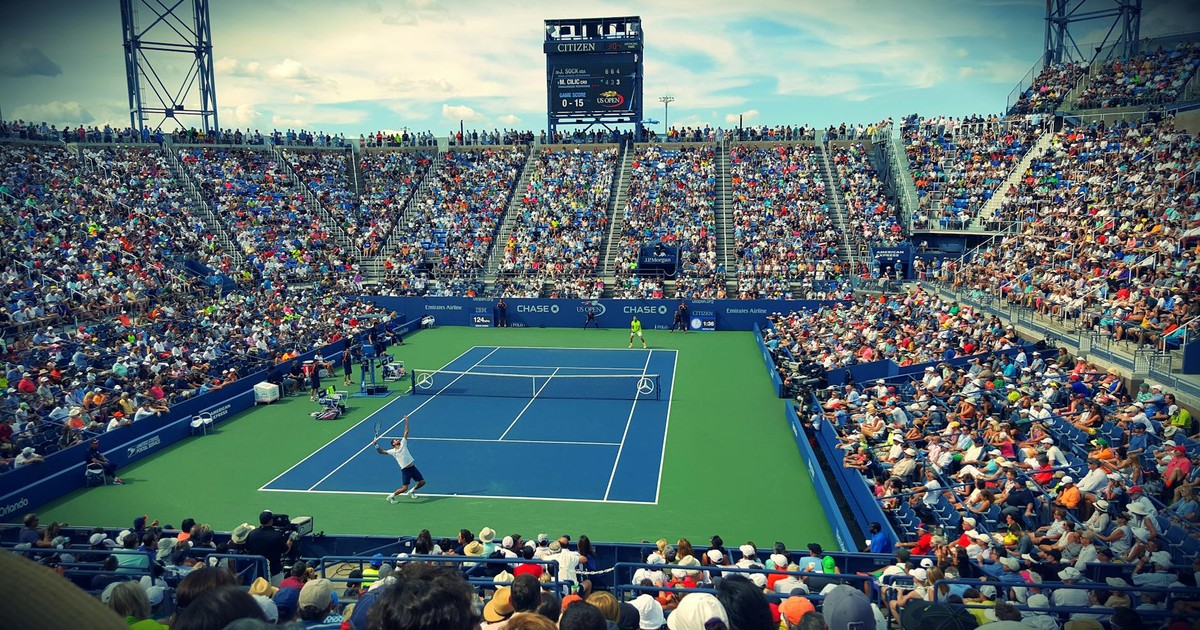
Hard Courts (US Open, Australian Open): The perfect canvas for the hybrid serve. Players can mix blistering flat serves down the T with heavy kick out wide. The true bounce allows for precise targeting and rewards both power and spin.
Clay (Roland Garros): Once the great neutralizer, clay has been conquered by spin. The heavy, high-bouncing kick serve is arguably more effective here, kicking up to absurd heights and creating severe angles. Power is tempered, but spin reigns supreme.
Conclusion: The Serving Arms Race and the Future of the Game
The evolution of the tennis serve from a point-starter to a point-ender has irrevocably changed Grand Slam tennis. It has created a sport where holding serve is the non-negotiable foundation of success. This arms race in power and spin has produced breathtaking athletic feats and shortened points, but it has also sparked debates about balance between serving and rallying.

Looking ahead, the trajectory points toward even greater specialization. We will see taller athletes with even more engineered motions, perhaps leveraging data analytics for hyper-precise targeting (the “aces to specific body zones” strategy). The return will continue to be the critical counter-punch, with perhaps a greater emphasis on psychological gamesmanship and disrupting server rhythm.
One thing is certain: the serve will remain at the epicenter of Grand Slam strategy. It is the shot that defines eras, builds legends, and in a single, whirring motion of power and spin, continues to change the very dynamics of the sport’s most hallowed stages.